Thursday, August 9, 2012

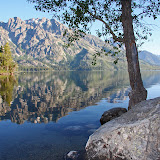
Teton and Yellowstone National Parks 2012


How is the Western Wyoming Ecosystem different from the ecosystem that you inhabit?

Thursday, May 24, 2012


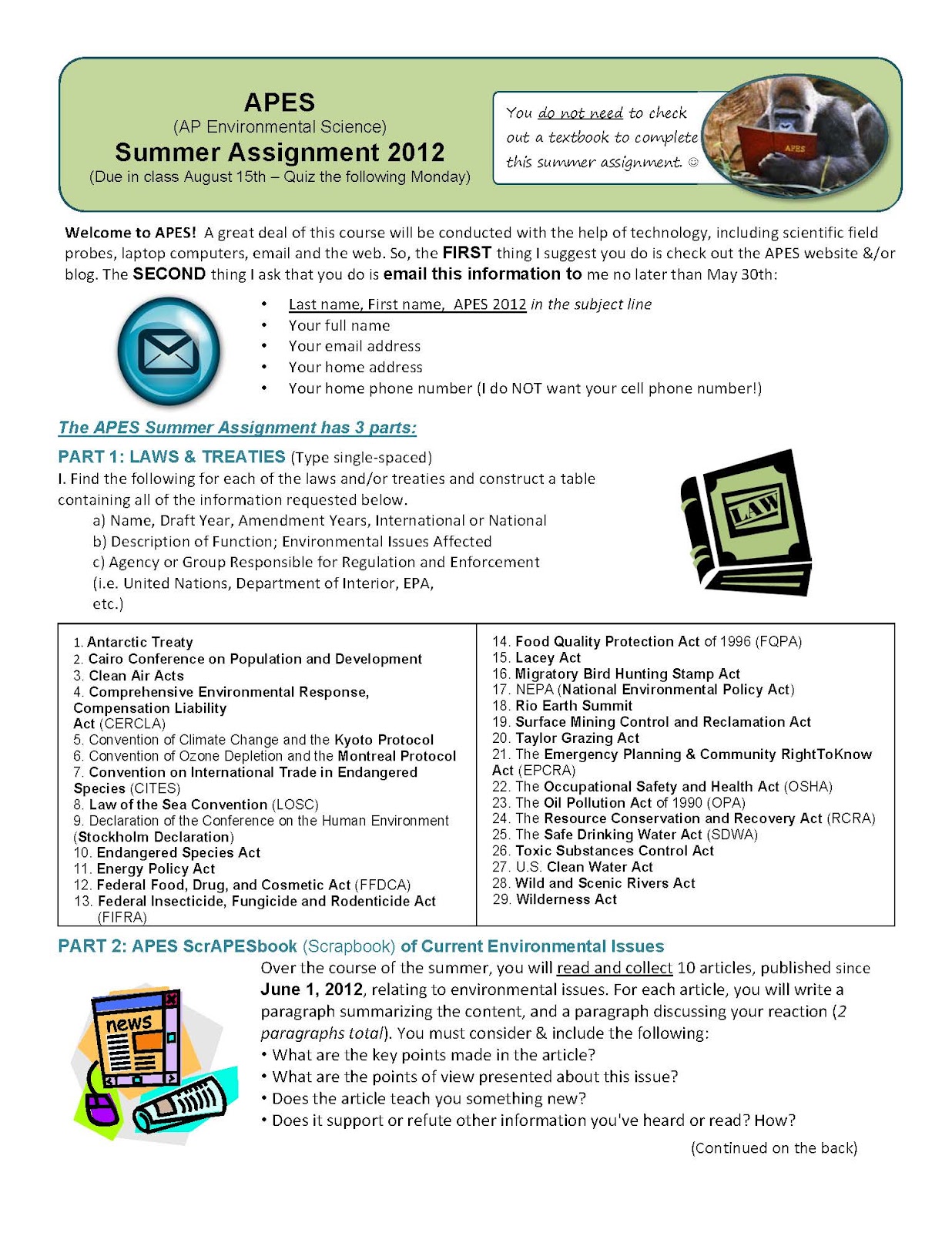
The APES Summer Assignment is required for all incoming APES students and will be collected for a grade in class on August 15, 2012. Please take pride in your work and complete it neatly. This is the first assignment for AP Environmental Science and in addition to creating a very useful study aid for your AP test, it also will give me an idea of your ability and work ethic.


Edline is hosting our new school website! Please be sure to add your email address to your Edline account so you can receive all class updates & announcements. Parents have real-time access to grades, school calendars, activites, and  more.

Sunday, August 14, 2011

If there was a basketball court...

Check out this video link from Ms. Burkhart!

Thursday, August 4, 2011

Welcome back to NAHS!

I am sure that you all had an amazing summer and are excited to get back to work. Please remember that I am here to support you in transitioning back into "school mode" and I am also available for tutoring. Let's work together to have a successful start this year. It is a lot easier to keep up than it is to catch up later!

Sunday, February 20, 2011

APES TED Video Assignment

Following is a great list of hyperlinked TED lecture videos (Compiled by Melissa Michalak, William H. Taft HS, San Antonio, TX and located at http://www.ted.com).
 
You must select 1 video. Summarize the key points, select and describe 2 factors that changed due to human influence, and post your results as a comment to this post on the blog. You must select a topic that has not yet been selected, so be prepared to let Dr. Scott know (in class only) which video you will choose as soon as possible! 
  1. Michael
     Pollan – Gives a plant’s eye view – 2007
  2. Michael
         Pritchard's water filter turns filthy water drinkable - 2009
  3. Jared
         Diamond on why societies collapse – 2003
  4. Paul
         Stamets on 6 ways mushrooms can save the world – 2008
  5. Yann Arthus-Bertrand captures
         fragile Earth in wide-angle – 2009
    (You tube)
  6. John
         Kasaona: How poachers became caretakers -2010
  7. James
         Balog: Time-lapse proof of extreme ice loss
  8. Corneille
         Ewango is a hero of the Congo forest – 2008
  9. Eric
         Sanderson pictures New York -- before the City – 2009
  10. Willie
         Smits restores a rainforest – 2009
  11. Jeremy
         Jackson: How we wrecked the ocean - 2010
  12. Stephen
         Palumbi: Following the mercury trail - 2010
  13. Al Gore
         on averting climate crisis – 2006
  14. Capt.
         Charles Moore on the seas of plastic – 2009
  15. Al
         Gore's new thinking on the climate crisis – 2008
  16. Nalini
         Nadkarni on conserving the canopy
  17. Edward
         Burtynsky on manufactured landscapes
  18. Brian
         Skerry reveals ocean’s glory and horror – 2010
  19. David
         Gallo shows underwater astonishments – 2007
  20. David
         Gallo on life in the deep oceans – 1998
  21. Richard
         Preston on giant trees – 2008
  22. Cary Fowler: One seed at a time, protecting the future of food – 2009
  23. Hans
         Rosling on global population growth – 2010
  24. Michael
         Shermer on strange beliefs – 2006
  25. Adam
         Savage on the Dodo bird
  26. Carolyn
         Steel on how food impacts cities
  27. Dennis
         vanEngelsdorp: a plea for bees – 2008
  28. Shimon
         Steinberg: Natural pest control… using bugs! - 2010
  29. William
         McDonough on Cradle to Cradle

Tuesday, January 11, 2011

Welcome Back!

Welcome back to school! Please remember to keep your agenda planner up to date, do your best on all of your work and turn it in on time! Now is a good time to get a head start on great grades!

Students in periods 3, 4, & 5 will have the privilege of working with Mr. Blinder, our student teacher. Updates on communications with Mr. Blinder will follow soon.

Have a great semester!

Sunday, November 14, 2010

How Should Species be Selected for the Endangered Species List?

What do you think should be the primary deciding factor in placing a species on the Endangered Species List? Which other factors should be considered?

Pygmy rabbit, Scientific American

Survival denied: Birds, fish, plant, pygmy rabbits lose out on endangered species protection Oct 7, 2010 09:10 AM 

"A variety of rare and threatened species have been denied protection under the Endangered Species Act (ESA) in recent weeks, including North America's smallest rabbit and a plant that may already be extinct in the wild.

The U.S. Fish and Wildlife Service (FWS), which makes the final determination on which species get protected status, ruled that some of these species deserve protection, although not as much as other, higher priority species."  Read more...

Wednesday, November 10, 2010

AP Environmental Science Invasive Species Report

actnow.com.au
If you would like to sign up for a specific invasive species for your project before class on Monday, you may sign up in a comment to this post. Remember that each student must report on a different species. Add your first name and last initial  if you comment anonymously so I know which student signed up!

Monday, November 1, 2010

Interesting Careers in Science

Biologists from the Field Museum are studying biodiversity in the Amazon, a tropical jungle. If you were a field biologist, which biome would you study and why?

Photo by Alvaro del Campo
Jaguars are the largest cats in the Americas. A jaguar print at Yagua River measured five inches across.

Wednesday, Oct. 27
"Life is tough for tropical mammalogists. They work on a group with a limited number of species, maybe 150 at places like the ones we are in, and most of those species are bats and rats. Other than monkeys, most of the large mammals in the Amazon are rare. To detect them, mammalogists look for signs — scat, tracks, scratch marks, anything to let them know that a species is here. Worse, they have yahoo ornithologists reporting weird bats, and clueless botanists seeing rare deer. But they have to follow up on these reports. They also have to work night and day. Some mammals (monkeys, for example) are out in daylight hours, but for most, nighttime is when they are active."

Monday, October 18, 2010

How do you approach "impossible" problems?

Mr. Geissbühler achieved the "impossible" in the article from the New York Times below. Can you describe a time when you solved an "impossible problem" and the process you used to solve it?                                                                                                                                                                                          
                        Luke Geissbühler
In a Takeout Container, a Trek to the Stratosphere

A 100,000-FOOT VOYAGE
Luke Geissbuhler tethered a video camera to a weather balloon and launched it in August from Newburgh, N.Y. The trip took 90 minutes, and a seven-minute video became a viral success.
By SAM GROBART
Published: October 12, 2010, The New York Times

Luke Geissbühler has raised the bar in the cool-dad competition.

In August, Mr. Geissbühler, a 40-year-old director and cinematographer, tethered a video camera to a weather balloon and sent both more than 100,000 feet into the stratosphere. The camera safely returned to the ground with the help of a small parachute.

The entire trip took about 90 minutes, but a seven-minute account of the voyage, posted on the video-sharing site Vimeo, has become a viral success, garnering more than one million views since it was first uploaded on Sept. 19. The breathtaking video, with its NASA-like views of the Earth’s curves, has made Mr. Geissbühler the latest in a long line of scrappy, do-it-yourself geek heroes. (It can be seen at www.brooklynspaceprogram.org/BSP/Space_Balloon.html.)

The instigator for this particular space program was Mr. Geissbühler’s 7-year-old son, Max, who had made more than a few requests for a handmade spacecraft.
“Our creative process works this way: he asks for the impossible,” Mr. Geissbühler said, “and then I have to tell him why it’s impossible. And then I start to question that. And then I start to investigate that.”

Tuesday, October 12, 2010

What do you think?

Twice a month, I will post a picture, a quote, a video, or a short reading for you to respond to. You must respond at least once during every grading period, but only once for each topic. Please keep your posts relevant, concise and school appropriate. Thanks!

Tuesday, January 12, 2010

Friday, January 8, 2010

Final exams are approaching!

The last opportunity for earning extra credit is the winter reading test on Monday, January 11 during lunch. Bring your book and arrive no later than 12:43 PM. Remember, there are no make-up exams!

Final exams are 3 weeks away. Please take some time this weekend to organize your study schedule and plan for success!

APES students will take the Unit 6 test, and begin The Apprentice Project during their final exam. For an introduction to the apprentice project, check out the Prezi below...

Biology students should begin reviewing EVERYTHING they have learned (or should have learned) this semester. Your Final Exam will be comprehensive.


APES Second Semester Service Learning
Check out this Prezi for an introduction to The Apprentice Project

Tuesday, September 9, 2008

APES and Biology Class Website

The first week of classes has been busy: textbooks, syllabi, safety tests, labs, tear-offs to return and so much more! For help keeping it all straight, click on the title of this post to sign up & join your class website. You can create a customized personal calendar, download all handouts given in class, check on homework and ask questions. There are also links to websites you can use to improve your understanding or to help you get your work done. Please post and share any additional Biology or AP Environmental Science websites that you think would be interesting or helpful.

Saturday, August 16, 2008

Welcome Back!

Welcome back to NAHS and to Biology/APES!

We will investigate scientific concepts together through experiments, activities, readings and projects this year. I think your science class will be challenging and interesting! I will also ask you to visit this blog regularly throughout the year to pose questions and post answers to help each other reach deeper understanding of the ideas presented in your science class.

I am looking forward to getting to know you all and wish you the best as you begin this year at NAHS.